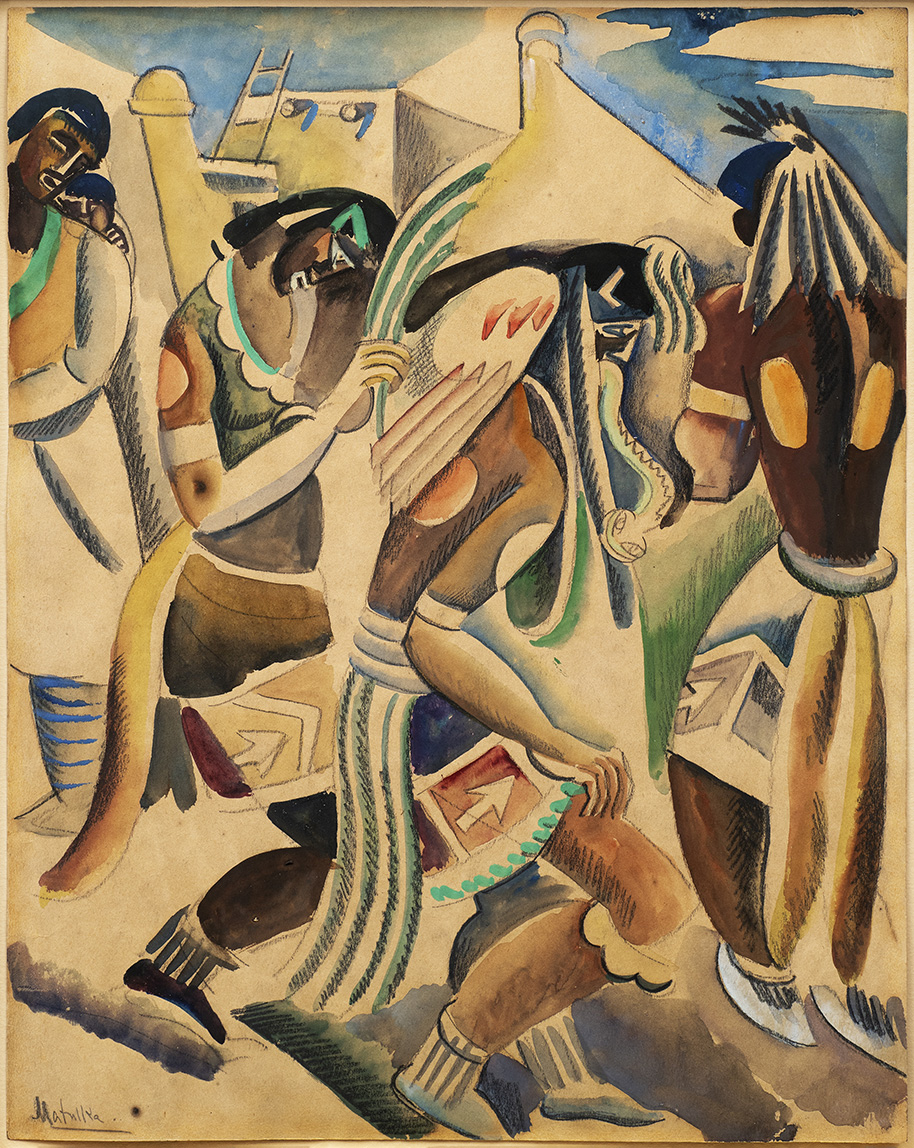
Jan Matulka and his parents left Bohemia in 1907 to make a new life for themselves in the United States, settling in New York City. Having already studied art in Prague for two years, Matulka enrolled at the National Academy of Design. Over the ensuing years, he proved to be an outstanding student. In 1917, he was awarded the Joseph Pulitzer Traveling Scholarship and chose to go to the American Southwest.
At that time, art colonies were growing in both Santa Fe and Taos. People like Robert Henri, an influential painter and teacher in New York, were encouraging artists through favorable reports of the region's unique atmosphere. When Matulka arrived, he visited various Native American Pueblos in Arizona and New Mexico. After returning to New York, he completed two well-reviewed paintings unlike anything that had been created by New Mexico's artists.
One factor in the artist’s unique style is Cubism. Introduced by Picasso and Braque just ten years earlier, it was a radical development in modern art and influenced Matulka greatly. "As a painter, he was the real thing. There is nothing false or unfelt in his work, nothing faked, nothing ill understood. He knew what he was doing, and he did it well." (The New York Times)